
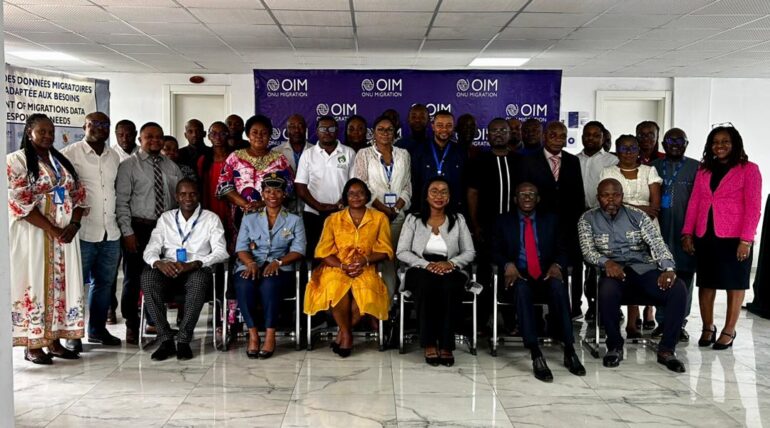
When an invitation arrives late, you show up anyway. That is exactly what Local Youth Corner Cameroon did this week, joining practitioners, government representatives and international partners at a three-day national capacity-building workshop organised by the International Organization for Migration (IOM) in Yaoundé, from 8 to 10 April 2026. The workshop, held at IOM’s headquarters on Rue CEPER and funded by the European Union, brought together organisations working on the protection and reintegration of persons in situations of mobility across Cameroon, including internally displaced persons, returning migrants and ex-associates.
LOYOC was among the civil society organisations invited to participate, a recognition of our active presence in this space, particularly through our ongoing reintegration and reconciliation work in the Far North Region in partnership with IOM and the EU, and our AMPLIFY peacebuilding project operating in the North West and South West regions.
What the workshop was about
The three days were structured around a clear purpose: to harmonise how reintegration is understood, measured and delivered across Cameroon. Over the course of the workshop, participants engaged with a rich body of knowledge covering the full reintegration cycle, from the moment a displaced person or ex-associate decides to return, to the long-term follow-up that determines whether that return is truly sustainable.
Day one laid the conceptual foundations, introducing IOM’s integrated reintegration approach and the national training cycle that IOM Cameroon has been rolling out across the country, building on sessions previously held in Bertoua, Douala, Bafoussam and Garoua. Day two deepened the technical content, with focused sessions on multidimensional reintegration, protection standards, DDR contexts and psychosocial wellbeing. Day three brought everything together around systems, data, coordination and national frameworks, culminating in the presentation of Cameroon’s National Framework of Indicators for Sustainable Reintegration, known by its French acronym CNIRD.
Three things that stayed with us
The first was the insistence on community as the centre of gravity. IOM’s Community Based Planning (CBP) methodology, presented in depth over the three days, does not treat reintegration as a service delivered to individuals. It treats it as a process co-constructed with communities. That means mapping stakeholders, holding consultations at accessible times and places, creating safe spaces for the least vocal voices, and ultimately producing a Community Action Plan that communities themselves own. For an organisation like LOYOC, which has spent years facilitating dialogue and community-level peacebuilding in some of Cameroon’s most fragile contexts, this resonated deeply.
The second was the attention given to psychosocial wellbeing. A dedicated session introduced participants to Psychological First Aid (PFA), the WHO-grounded approach to supporting people who have recently experienced distress. The facilitator, BORE Tiena of IOM, was clear: PFA is not therapy, and it is not something reserved for specialists. It is structured, human-centred support that any trained frontline worker can provide. Knowing when to listen without pressure, when to refer, and when to simply help someone access basic services can make a significant difference in whether a person begins to recover or continues to spiral. This is directly relevant to LOYOC’s casework in the Far North, where many of the people we engage with carry the weight of conflict, displacement and loss.
The third was the CNIRD framework. This is Cameroon’s attempt to build a nationally owned, internationally aligned system for measuring whether reintegration is actually working. It covers six dimensions: economic, social and community, psychosocial, access to basic services, security and justice, and environmental. Each dimension has concrete, measurable indicators with clear definitions, data collection methods and mandatory disaggregation requirements by sex, age, region and population category. It is aligned with the Global Compact for Migration, the Sustainable Development Goals, international DDR standards, and the Sendai Framework on disaster risk reduction. For partners like LOYOC who contribute data and field-level reporting, understanding this framework is increasingly important. It shapes what gets measured, what gets reported, and ultimately what gets funded.
The broader conversation
The workshop also surfaced a question that sat at the centre of every discussion: what does it actually take for a community to accept someone back? The answer, drawn from days of shared reflection, was not simple. It requires economic opportunity that does not feel like preferential treatment for those who caused harm. It requires dialogue that does not force reconciliation before communities are ready. It requires data that captures not just what was delivered, but how people feel, whether they are stigmatised, whether they feel safe, whether their children are in school. And it requires coordination across government, civil society, international organisations and communities themselves, sustained over time and not just for the duration of a project cycle.
These are not abstract questions. They are the daily realities of the work LOYOC carries out in the field.
Looking ahead
LOYOC remains committed to contributing meaningfully to Cameroon’s reintegration ecosystem. The knowledge and connections gained from this workshop strengthen that commitment. We are grateful to IOM Cameroon for the invitation and for the quality of the training, and to the European Union for funding this important initiative. We look forward to applying these learnings in our programmes and to continuing the partnerships that make community-centred reintegration possible.